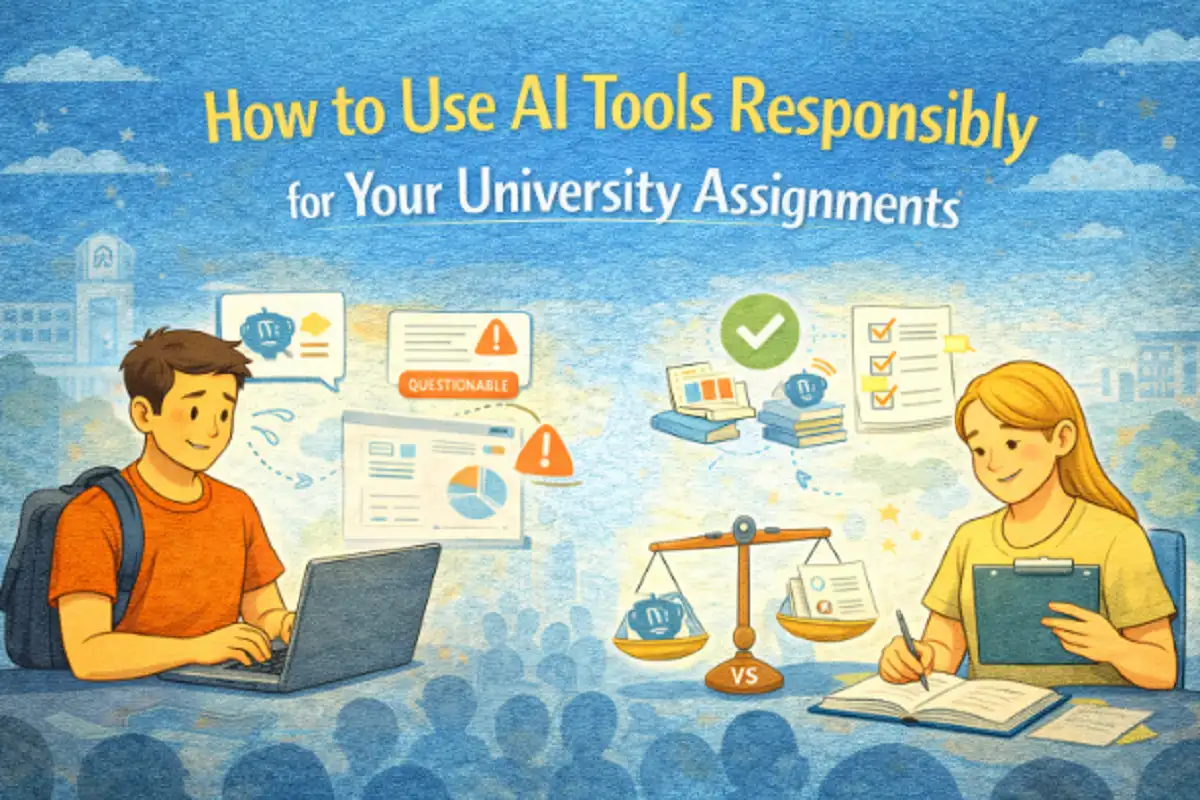
The academic landscape has shifted faster in the last two years than in the previous twenty. Walking into a lecture hall in 2026 feels different; every student has a suite of AI assistants at their fingertips. But here is the reality: while AI can outline a paper in seconds, it can’t earn you a degree. Professors are no longer just looking for the right answers—they are looking for your “voice,” your critical thinking, and your ability to argue a point.
Using AI responsibly isn’t about avoiding the technology; it’s about using it as a scaffold, not the entire building. If you rely on a bot to do the heavy lifting, you miss out on the cognitive development that university is actually for. Let’s break down how to stay ahead of the curve without triggering academic integrity red flags.
The “Co-Pilot” Philosophy
Think of AI as a research intern, not the lead author. An intern can find sources, summarize a long PDF, or suggest a structure for your thoughts. However, you wouldn’t let an intern sign your name to a final report without checking every single word.
The biggest trap students fall into is the “copy-paste” cycle. This is where most academic careers hit a wall. When you are overwhelmed by a mounting pile of coursework and think, “I just need someone to do my assignment for me,” it’s often a sign that your time management or your understanding of the core material has slipped. In these moments, seeking professional guidance from a reliable source like Myassignmenthelp Services can be a safer, more educational route than blindly trusting a chatbot that might hallucinate facts.
Brainstorming vs. Drafting
The best way to use AI responsibly is during the “Blank Page Phase.” We’ve all been there—staring at a blinking cursor for three hours. You can ask an AI to “Suggest five different perspectives on the impact of remote work on urban planning.”
This gives you a starting point. Once you have those perspectives, close the AI tool. Open a fresh document and start writing in your own words. Why? Because your professors can tell the difference between “standardized AI prose” and the unique, slightly messy, but brilliant way a human undergraduate thinks.
The Ethics of AI Research
AI tools are notorious for “hallucinating” citations. They will give you a perfect quote and attribute it to a peer-reviewed journal that doesn’t exist. If you use a quote provided by an AI without verifying it in your university library database, you are committing a form of academic fraud, even if it was accidental.
Responsible use means every fact an AI gives you must be cross-referenced. Treat AI output as a “rumor” until you find the primary source. This habit doesn’t just keep you out of trouble; it actually helps you learn the material.
Navigating the World of Business Assignments
For those of you in commerce, finance, or management tracks, the stakes are even higher. Business studies in 2026 require a blend of data literacy and ethical decision-making. AI is great at crunching numbers, but it’s terrible at understanding the nuance of corporate culture or the ethics of a supply chain.
When you’re deep into a complex case study and the data feels overwhelming, you might need a more specialized touch. For instance, getting high-quality business assignment help ensures that your analysis isn’t just a collection of generic AI-generated bullet points, but a deep, structured look at market trends and financial health that follows your specific university rubric.
Maintaining Your Unique “Human Voice”
Google’s search algorithms and university Turnitin checkers are looking for the same thing: Perplexity and Burstiness. * Perplexity is the complexity of your sentences.
- Burstiness is the variation in your sentence length.
AI tends to write sentences that are all roughly the same length and rhythm. Humans write “bursty.” We might have a long, flowing sentence describing a theory, followed by a short, punchy one. To keep your work human, read it out loud. If it sounds like a robot reading a manual, change it. Add personal anecdotes, refer to things your professor said in a specific lecture, and use contemporary examples from the news.
A Step-by-Step Guide to an AI-Augmented Assignment
If you want to use these tools without losing your integrity, follow this workflow:
- Understand the Rubric: Read what your tutor actually wants. AI often misses the specific “learning outcomes” hidden in your syllabus.
- The Prompt Stage: Use AI to explain difficult concepts to you “like I’m a 20-year-old student.” This is for your understanding, not for the paper.
- The Human Draft: Write the first 500 words without any digital help. This sets your “voice” for the rest of the piece.
- The Polish: Use tools to check your grammar or suggest more professional synonyms, but never let the tool rewrite entire paragraphs.
- The Citation Check: Use a dedicated reference manager (like Zotero or Mendeley) to ensure your bibliography is 100% real.
Dealing with the Pressure
The pressure to perform in a globalized job market is intense. Sometimes, the “responsible” thing to do is admit when you are out of your depth. Using AI to cheat is a shortcut to nowhere, but using professional academic services to understand the “how” and “why” of an assignment is a legitimate study strategy.
About The Author
“Hi, I’m Min Seow, and I’ve spent the better part of the last decade helping students navigate the increasingly complex world of higher education. As an academic strategist at MyAssignmentHelp.services, my mission is to bridge the gap between classroom theory and real-world application.